Radon Levels High in Some Canyon Homes
By Chad Billmyer
Special to Canyon News
When Canyon resident Beth Preminger added an Airthings air monitor to her home on the 500 block of Amalfi Drive a few years ago, high radon readings surprised her.
“I had very high levels in our basement, over 15 pCi/L,” Preminger said. “I confirmed these levels with an official radon test kit from University of Kansas and then hired a radon mitigation company to help us solve our issues.”
The Environmental Protection Agency (EPA) sets an "action level" of 4.0 picocuries per liter (pCi/L). Research shows that long-term exposure to elevated radon levels significantly increases the risk of lung cancer. While smoking is the leading cause, radon is the second leading cause of lung cancer, responsible for an estimated 21,000 deaths annually in the United States.
Based on indoor radon test results reported to the California Department of Public Health (CDPH) through early 2016, 22 of 106 tests (20%) in the 90402 zip code showed radon levels above 4.0 pCi/L. The highest level reported was 18.6.
A year ago, after the Palisades Fire, this reporter activated an indoor Airthings air monitor on the 400 block of West Channel Road and like Ms. Preminger found levels of radon over 4 pCi/L in the home when the windows were closed for extended periods.
In recent history, Santa Monica Canyon home buyers haven’t been concerned about radon. Frank Langen, who focuses on Canyon residential real estate shared, “In the 30 years that I’ve been selling real estate here I’ve only encountered two radon inspections from the buyer side. Buyers and typically the inspector tend to say that this is not an area that has radon. When buyers did inspect, they were represented by agents from areas where there is bedrock and radon is relevant.”
Bjorn Farrugia, a real estate agent who also covers the neighborhood added, “I haven’t heard of anyone doing a radon test.”
For decades, radon, a naturally occurring radioactive gas, has been a footnote in California’s environmental ledger, often dismissed as a problem for the granite-heavy basements of the East Coast. However, a 2005 geological survey by the California Department of Conservation identified Santa Monica Canyon as an area worthy of radon testing. The canyon sits adjacent to a known hot spot visible on their survey.
A year ago, comprehensive testing of soil and air at LAUSD’s Canyon Charter Elementary on January 18 and 25, 2025 did not include tests for radon. A representative from the LAUSD Office of Environmental Health and Safety did not respond to a request for comment.
From Airthings headquarters in Oslo, Norway, Annabel Robertson writes, “What we see is that, especially when monitoring over time, radon levels can vary hugely from house to house, even if they're on the same street. This can be down to how a house is built, how it's used (how good ventilation is, whether people open windows, or how "airtight" it is, if a main living space is in a basement), whether there are cracks in the foundations or around plumbing through which radon can enter. Weather and seasonal changes can also cause levels to spike. While we can deduce from our data and other sources, such as the EPA's radon zones map, that areas are more likely to have higher levels of radon, the only way to really know a home's actual radon exposure is to monitor, preferably over time, to gauge the long-term average.”
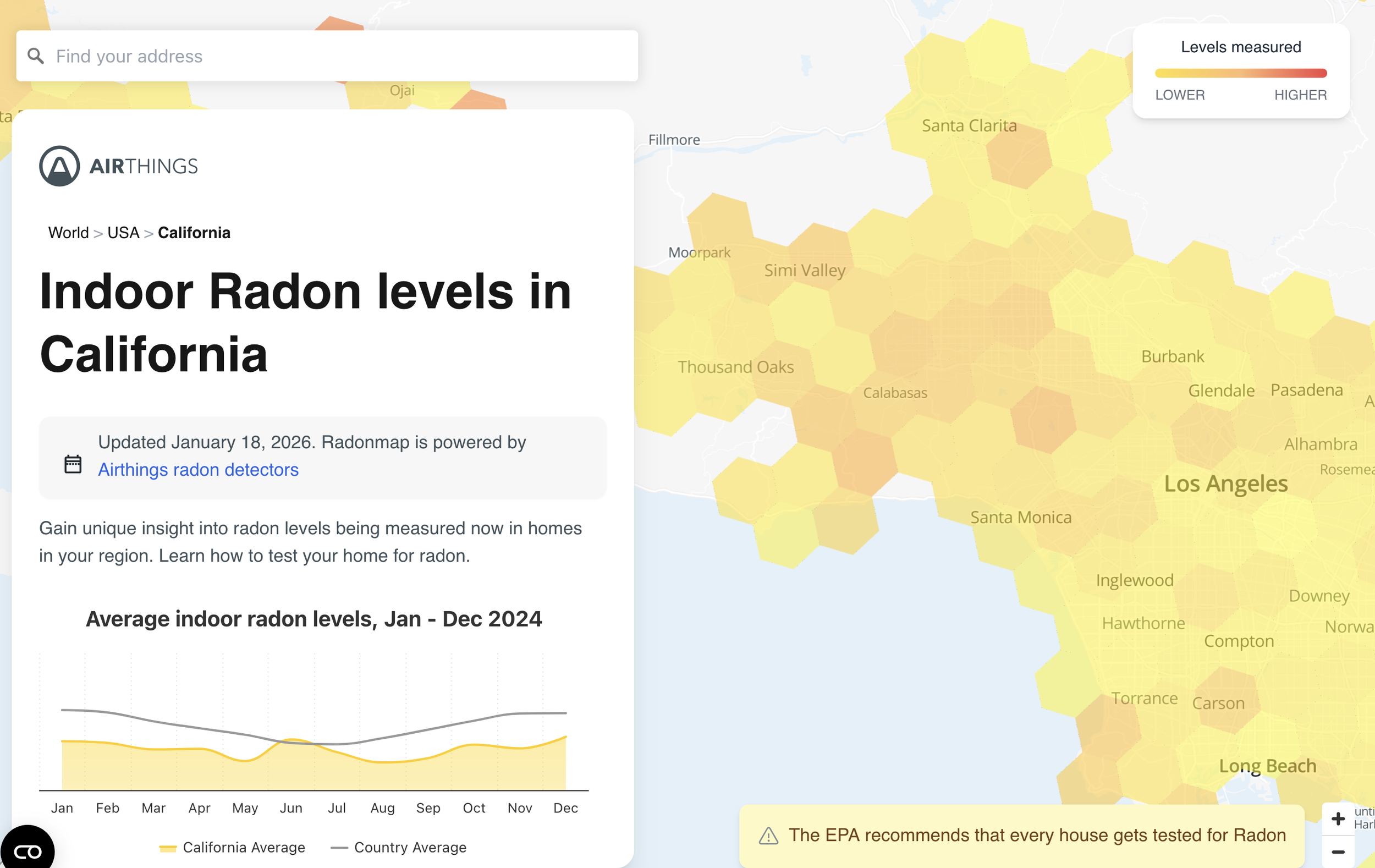
Airthings publishes a radon map that aggregates results from their monitors. Following the Palisades Fire, Harvard University deployed 50 Airthings monitors to homes in the area as part of a longitudinal study. However, those monitors do not have radon sensors.
The Invisible Resident
Radon is the byproduct of the natural decay of uranium in soil and rock. While it dissipates harmlessly in the open air, it can seep through foundation cracks, concentrating to dangerous levels inside tightly sealed homes.
The reason for the Canyon’s predicament lies in its geology. While much of Los Angeles sits on deep layers of alluvial sand, Santa Monica Canyon is built upon and carved out of the Monterey Formation.
The Monterey Formation is a geological unit known for its high phosphate and uranium content. Over millions of years, the uranium decays into radium and then into radon gas. In Santa Monica Canyon, this process is exacerbated by two factors:
Porous Marine Terraces: The neighborhood sits on "uplifted marine terraces"—flat benches of land created by ancient sea levels. These terraces are composed of porous materials that allow radon gas to migrate easily from the deep shale to the surface.
Fractured Bedrock: The tectonic activity that created the Santa Monica Mountains has left the underlying rock heavily fractured. These cracks act as "highways," funneling gas directly toward the foundations of homes.
The Burden of Concern
How worried should a resident of Mesa Road or Entrada Drive be? Public health experts suggest a stance of "informed vigilance.”
“You can’t see, smell, or taste radon gas, so it is easy to ignore the risk it carries,” according to the Memorial Sloan Kettering Cancer Center.
Michael Bellamy, PhD at MSK adds, “I think the EPA has a great message, which is very clear: ‘Test. Fix. Save a life.’”
The risk is particularly acute for the Canyon’s older homes, which may have aging foundations, as well as newer, energy-efficient "tight" homes that trap indoor air more effectively than draftier structures.
Taking Action
Because radon levels can vary wildly from one house to the next, even on the same block, experts say the only way to know the risk is to test.
In a 2016 symposium paper, Ronald K. Churchill, Ph.D., senior engineering geologist at California Geological Survey, California Department of Conservation, laments the misperception that radon risk is low in California.
For the residents of 90402, the path forward involves three specific steps:
Test: The CDPH offers discounted or free testing kits (via certain public libraries) to California residents. Short-term tests (2-4 days) provide a quick snapshot, while long-term tests (3-12 months) offer a more accurate picture of average exposure. An Airthings device with a radon sensor will begin to report results after a few weeks of calibration.
Mitigate: If a home tests above 4.0 pCi/L, mitigation is remarkably effective. Most systems involve "sub-slab depressurization"—a series of pipes and a small fan that vent the gas from beneath the house directly into the atmosphere.
Disclose: In California, radon is a material fact in real estate transactions. Proactive testing and mitigation can prevent complications during the high-stakes property sales typical of the 90402 market.
As the sun sets over the Pacific, casting long shadows across the Canyon’s walls, the ground beneath residents’ feet demands a new kind of attention, one that looks past the view and into the chemistry of the earth.
The following websites were used in researching this article:
https://radonmap.com/usa/california
https://www.cdph.ca.gov/Programs/CCDPHP/DEODC/EHIB/Pages/EIS/Radon-Data.aspx
https://www.conservation.ca.gov/cgs/Documents/Publications/Special-Reports/SR_182-Radon-Map.pdf
https://aarst.org/wp-content/uploads/2021/02/2016-Symposium-Churchill-Track-1-0916-2016.pdf