

Kenny Sly, who worked his way out of homelessness with the help of the Pacific Palisades Task Force on Homelessness, trims foliage on one of the Santa Monica Canyon medians that he maintains. Photo: Courtesy of Sharon Kilbride
By Laurel Busby
News & Information Editor
Losing their mothers profoundly changed the lives of Sean Ogden, 58, and Kenny Sly, 66.
Sly’s mother died when he was 16, and he left his home in New Orleans for a life on the road. He worked at an array of jobs, including plumbing, oil drilling, shipping, iron work, and fumigation, and spent time in varied places, including Texas, Mexico, Mississippi, and Chicago, before moving to Los Angeles. The freedom of homelessness held an allure for him for most of his adult life.
“Being homeless was a fantasy of mine,” Sly said. “I was thinking I never wanted to be housed…. I never wanted the government to notice me.”
Ogden, on the other hand, grew up in Santa Monica, and had purchased a house in Ventura, when his mother died 18 years ago. She had worked with music producer Phil Spector and was a key witness at his murder trial. The first trial ended with a hung jury, and, before the second trial, Ogden’s mother died suddenly. Her son believes she was murdered, and, around the same time, he reports being kidnapped, zip-tied, and beaten.
In the aftermath, he spiraled, lost his house, and began living on the streets.
“I went on a long, long drug binge,” Ogden said. “I wanted to kill myself. Me and my mom were really close.”
Previously, he had worked installing tile and laying carpet, but he could no longer manage those jobs. Instead, he moved into a series of homeless encampments on local hillsides and spent his days both surfing the waves and at times stealing to get enough food to maintain himself and his friends.
“I’m not proud of it,” said Ogden, but he did appreciate the positive aspects of the lifestyle, such as connecting with wildlife and his unhoused friends. At one time, “I was taking care of four people in Tuna Canyon. I had a lot of good times up there. I got to know a lot of people. It was pretty cool. It was pretty mystical.”
Sharon Kilbride, a past president of the Pacific Palisades Task Force on Homelessness (PPTFH), said that Ogden had been living on the Via de las Olas bluffs in 2014 when a fire broke out at one of the encampments. The area, which was dubbed Meth Mountain, had about 35 people living on it, and 20 accepted housing after the fire. Ogden did not.
“I didn’t want to be housed in a building with a lot of people I didn’t know,” Ogden said. “I’m more of an outdoors person. I like being outdoors.”
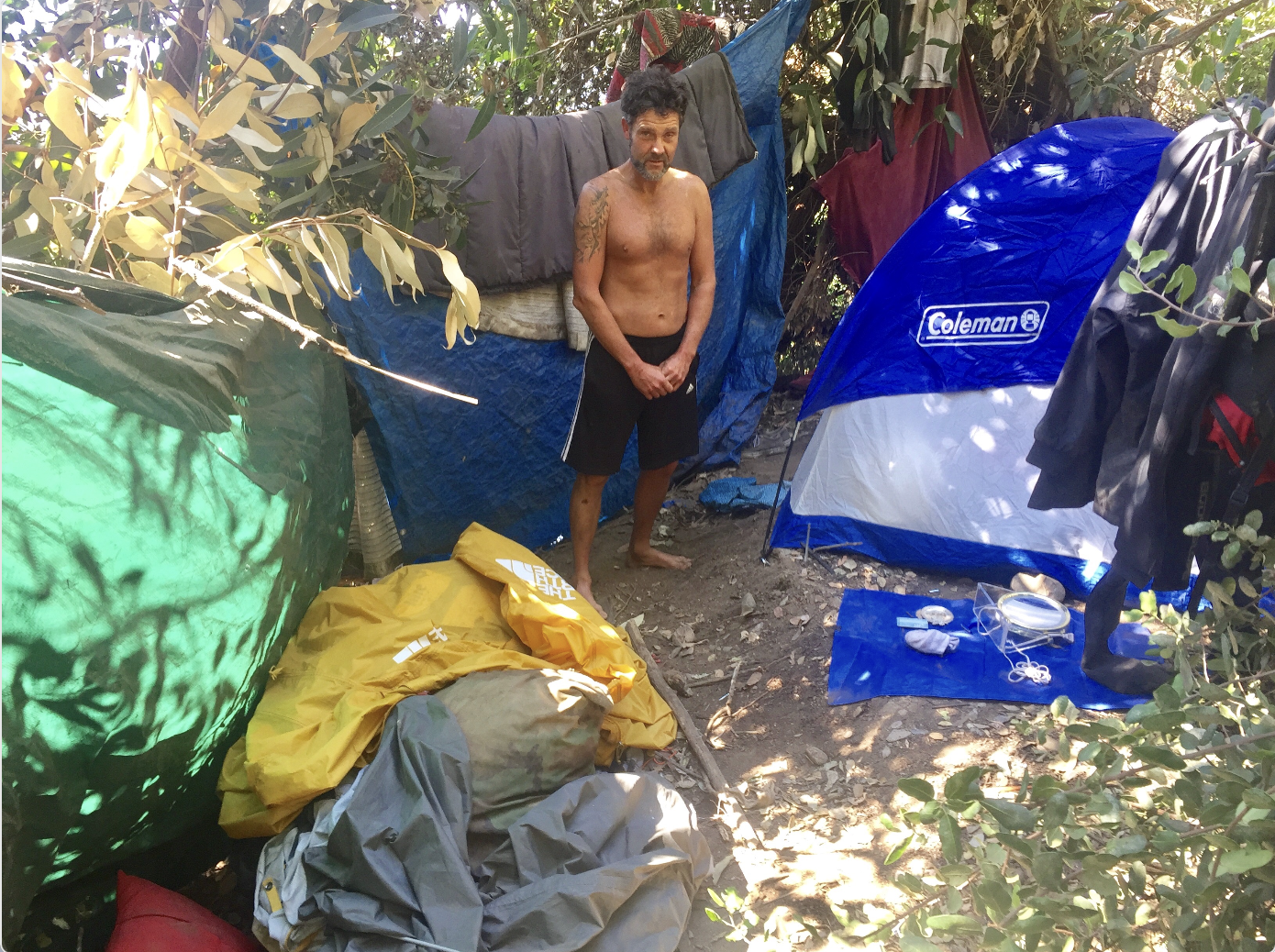
Sean Ogden during the period when he lived on a local hillside. Photo: Courtesy of Sharon Kilbride
For the next 12 years, Ogden continued to resist attempts to help him move into housing, but the fire had spurred the creation of the PPTFH, which enlisted the nonprofit organization, The People Concern, to provide the Palisades with three outreach workers, who repeatedly made contact with Ogden, Sly, and other unhoused people in the area.
The resulting contacts often evolved into relationships, which were a major facet of why both Sly and Ogden eventually accepted housing. However, more than friendship was required.
Both Ogden and Sly had to manage complex issues, such as identity theft, which led to them not receiving government benefits like Social Security. The PPTFH outreach staff worked to get those matters straightened out, which was necessary in order to secure them housing, Kilbride said. The process wasn’t speedy though. For many people living on the streets, the housing application can take six months to a year or longer, and staying in contact with unhoused people over that time is its own challenge.
Some, like Ogden, don’t have phones. The police also routinely take down the tent encampments, so unhoused people are often on the move and don’t have a set location. The L.A.P.D. beach detail doesn’t only provide enforcement though. They are part of the team that gets to know unhoused people, and the officers work in conjunction with the PPTFH to aid the process of obtaining housing for them.
Sly said that his relationships with the LAPD beach detail over the years had been beneficial.
“They encouraged me to give up my old thinking,” he said.
To fund the various aspects of the program, the PPTFH requires roughly $300,000 annually, which entails extensive fundraising, Kilbride said. Because of the Palisades Fire, there have been far fewere community members to donate to the PPTFH. Current funding is expected to run out in May unless enough donations come in to keep it going.
In addition, the number of regular volunteers has dropped from 30 to 6, so the program is even more reliant on The People Concern’s three outreach workers, including Glenda Sherman, who both Sly and Ogden cited as a key person who helped them obtain housing.
Ogden, who moved to a Wilmington apartment earlier this year, now enjoys taking a hot shower anytime he chooses, while Sly has treasured the chance to support his extended family by having more stability himself at his Crenshaw apartment. Sly has had an apartment for about 2-1/2 years.

Kenny Sly enjoys his new apartment. Photo: Courtesy of Sharon Kilbride
“It has opened some doors for me,” Sly said. “Before I couldn’t take care of my family. My idea of family was being on my own. Now I have a lot of bills, but I’m now able to manage them.”
His brother is dying, so Sly is working to pay for a cemetery niche at Inglewood Cemetery, and he also bought headstones for his grandparents’ graves. In addition, he has focused on improving his health, because past exposure to asbestos and benzene severely impacted his breathing. Medical staff of The People Concern found him the correct medications, and he has stopped drinking, smoking, and doing drugs. In addition, he has added special teas and exercise to his daily regimen.
Before “I was unhealthy,” Sly said. “I passed out several times. I was literally dying.”
For Ogden, moving in an apartment helped him feel more settled. He kicked his drug addiction through a Santa Monica rehabilitation program called Clare/Matrix, which includes regular meetings with a counselor, who has helped him process his emotions.
“I talk about things instead of keeping things bottled up in me,” Ogden said. “By learning about the things that make me want to use drugs, it’s taken the urge away and the craving away. I’m pretty happy with that.”
Both also enjoy their weekly work in Santa Monica Canyon. For about five years, Sly has maintained either the pedestrian tunnels under PCH or the medians at both Mesa and Entrada. Now, Ogden has taken over the task of cleaning the tunnels, and both enjoy the chance to labor outdoors.
“I love cleaning the tunnels,” said Ogden, who noted that an extra benefit is that he sometimes gets tips in addition to his $50-60 pay for from the Boca Neighborhood Association. “It’s rewarding. People are telling me ‘Thank you for cleaning.’ I’m giving back to the community. I like to keep the beach clean since I’ve surfed out there since I was six years old. If the waves are good, I can also take a break to surf.”
(Visit this link to donate to the PPTFH.)
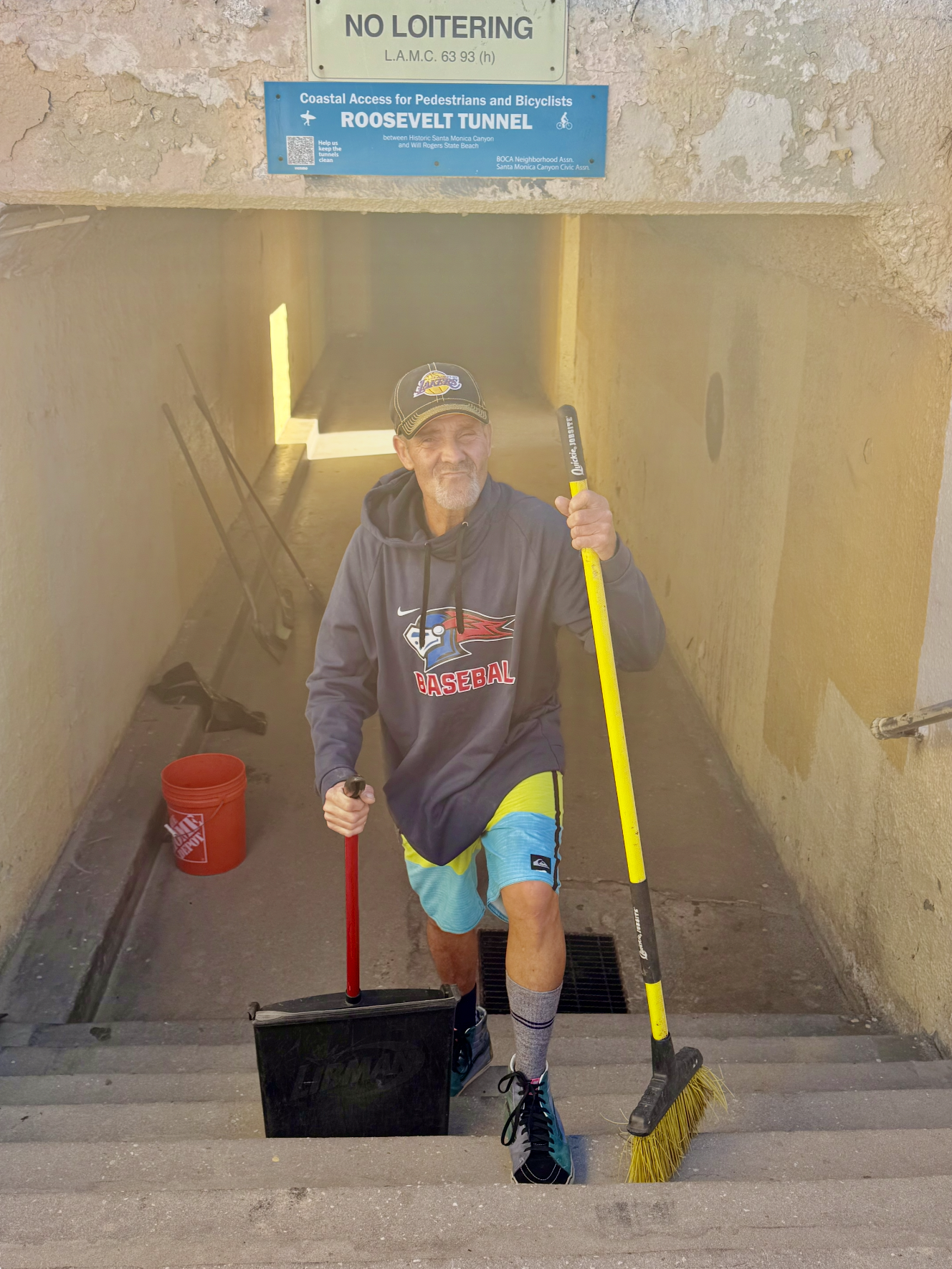
Seth Ogden cleans the pedestrian tunnels under the Pacific Coast Highway. Photo: Courtesy of Sharon Kilbride
