
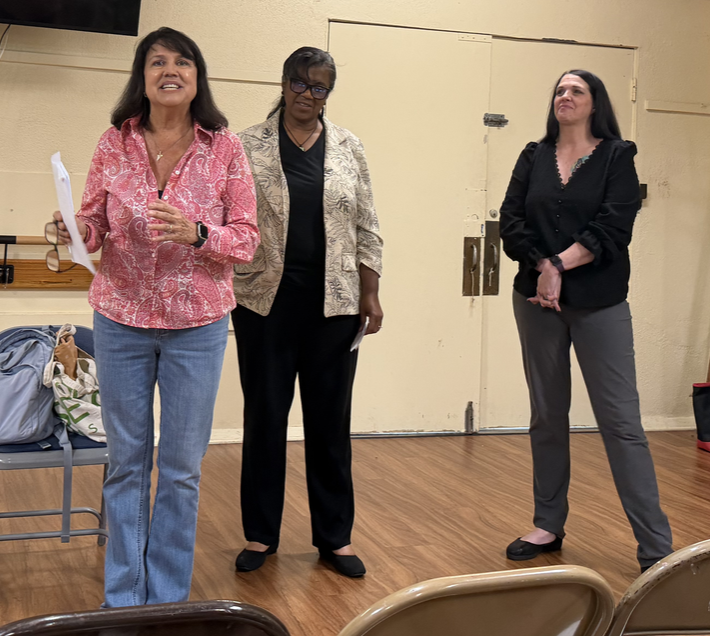
The Canyon Alliance Board Member Sharon Kilbride and other representatives from the Pacific Palisades Task Force on Homelessness shared information at The Canyon Alliance’s annual membership meeting. Photo: Sue Pascoe
By Sue Pascoe
Courtesy of Circling the News
About 100 Santa Monica and Rustic Canyon residents attended The Canyon Alliance annual membership meeting held on Nov. 10 at the Rustic Canyon Recreation Center.
The Alliance consists of residents from Upper and Lower Rustic Canyon, Upper and Lower Santa Monica Canyon, and Boca (the mouth of the Canyon) – two canyons and five neighborhoods, nestled between Chautauqua Boulevard in Pacific Palisades and the city of Santa Monica.
Attendees were welcomed by Board President Eric Balfour, who said, “I’m so grateful we get to live here.” He further addressed the tight-knit community. “Before the Palisades Fire, we used to wave at each other. After the fire, when we see each other, we hug.”
Doug Suisman, a past Alliance president, long-time Canyon resident, and internationally recognized American architect/urban designer/author, helped orient those new to the Canyon with a historic talk and slide show.
“When the fire broke out, we learned we could not depend on the government to save the day,” Suisman said. “We were not prepared.”
In the aftermath of the fire, Suisman spearheaded an effort to bring the five neighborhoods together in part through changing the Santa Monica Canyon Civic Association’s name to The Canyon Alliance.
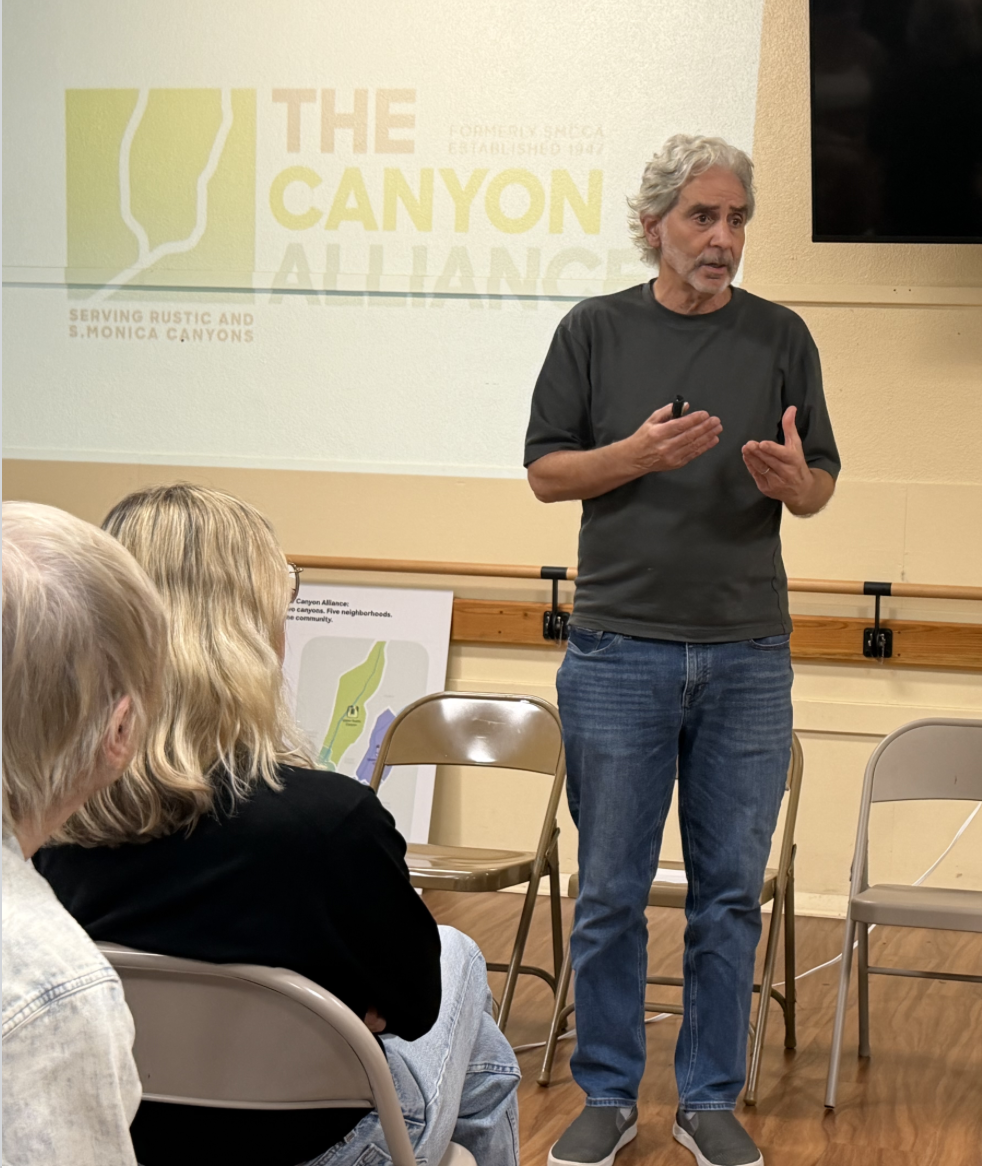
Former Canyon Alliance President Doug Suisman presented information about the organization’s history. Photo: Sue Pascoe
Although Santa Monica Canyon lies next to the City of Santa Monica, it is part of Los Angeles, which annexed it in 1925. Some people in the Canyon receive mail addressed with the Palisades 90272 zip code, while others receive mail labeled Santa Monica 90402, even though they live in Los Angeles.
“Some day we’ll get a Canyon Post Office,” Suisman said.
With predictions of a “super” El Niño this year, possible floods are an Alliance concern, because of the Canyon’s two creeks, which siphon water over a large watershed. Rustic Creek begins in Topanga State Park in the Santa Monica Mountains, below Mulholland Drive, flows past Will Rogers State Historic Park and is joined by natural year-round streams and side channels like Rivas Canyon that drain water from eight miles away.
Santa Monica Creek also includes eight miles of water runoff from Sullivan and Mandeville Canyons.
The two creeks converge in Lower Santa Monica Canyon near West Channel and East Rustic Road before flowing into the ocean.
L.A. County has put concrete along portions of the channel/creeks, while other portions of the creek belong to residents. If there is a flood, L.A. County only responds to issues within the channels it owns. If water washes into the streets, then it becomes a L.A. City issue. If water floods over the banks onto a private yard, the owner is entirely responsible for the response.
In a prior story on The Canyon Alliance website, editor Laurel Busby provided information about flood insurance (https://www.the-canyon.org/news/fema-flood-insurance?rq=insurance). (Suisman and Balfour praised Busby’s work on stories about and for the area that can be found on The Canyon Alliance website and urged people to look at them. If anyone has a story of interest, they were told to email Busby directly laurelbusby@mac.com)
If there are issues that L.A. City can address, Arus Grigoryan, Councilmember Traci Park’s area director, recommended calling 311.
“Please use 311,” she said. “They will respond right away – but only for city issues.”
She emphasized that 311 might be faster than calling the Councilmember’s office about a problem.
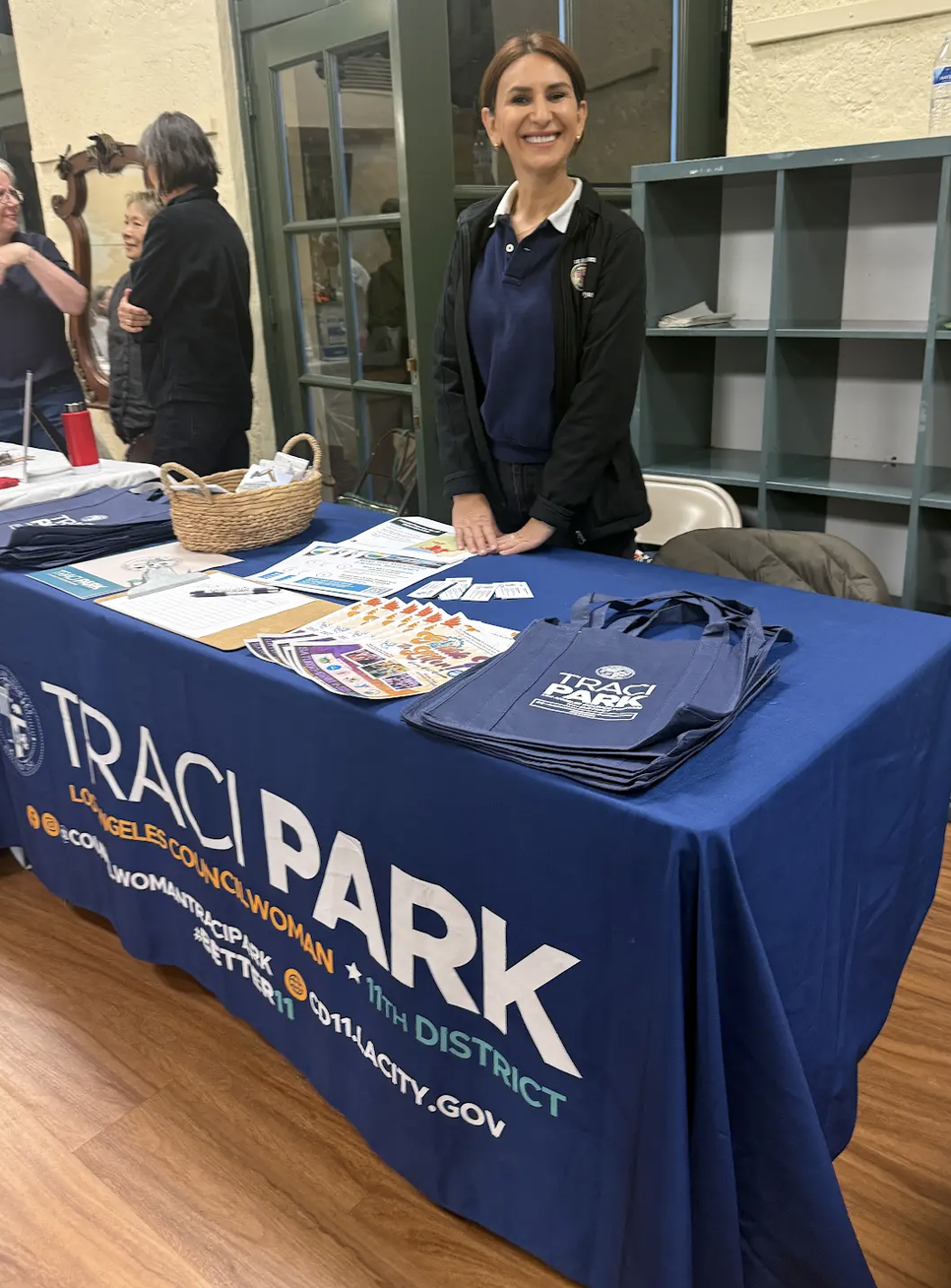
Arus Grigoryan from City Councilmember Traci Park’s office was one of the local officials who attended the meeting. Other communtiy organizations, including Fire Safe Palisades, were also present. Photo: Miriam Bookey
Also, on the program was Alliance Board Member Sharon Kilbride, who spoke about the Pacific Palisades Task Force on Homelessness (PPTFH). Formed in 2014, the organization raised money to pay social workers to help the unhoused out of the hillsides and streets into housing.
Over the years, “more than 244 unhoused have been helped; of those, 198 have been housed permanently, said Kilbride, a past president of the PPTFH and descendant of the Marquez family who held the original Rancho (Rancho Boca de Santa Monica), which became the Palisades, including Santa Monica Canyon.
About 400 encampments have been cleared out of the hillsides surrounding the Canyon through PPTFH’s work. Some of the unhoused have been paid to clean the medians and keep the tunnels under Pacific Coast Highway clear of sand.
Additionally, the Los Angeles Department of Police beach detail helps PPTFH members when they are faced with an aggressive vagrant. For example, the day after the meeting, a man was found sleeping in a pedestrian tunnel, turned violent, and was taken into custody after he was found to have been accused of felonies in Florida.
The City of Santa Monica allows the unhoused to sleep on the beach and in doorways, so some people naturally migrate north into Santa Monica Canyon.
Due to the Palisades Fire, many of the organizations and families who previously donated to PPTFH are focused on rebuilding efforts, so funding for this organization is reaching a critical juncture.
“Many of our former donors (Pacific Palisades) lost homes and are suffering financial hardships,” Kilbride said in an appeal to Canyon residents. “I’m hoping you can step up to keep this organization going.”
Helpful Links:
To contribute to PPTFH, visit this link.
For emergency and non-emergency resources, visit The Canyon Alliance resources page.
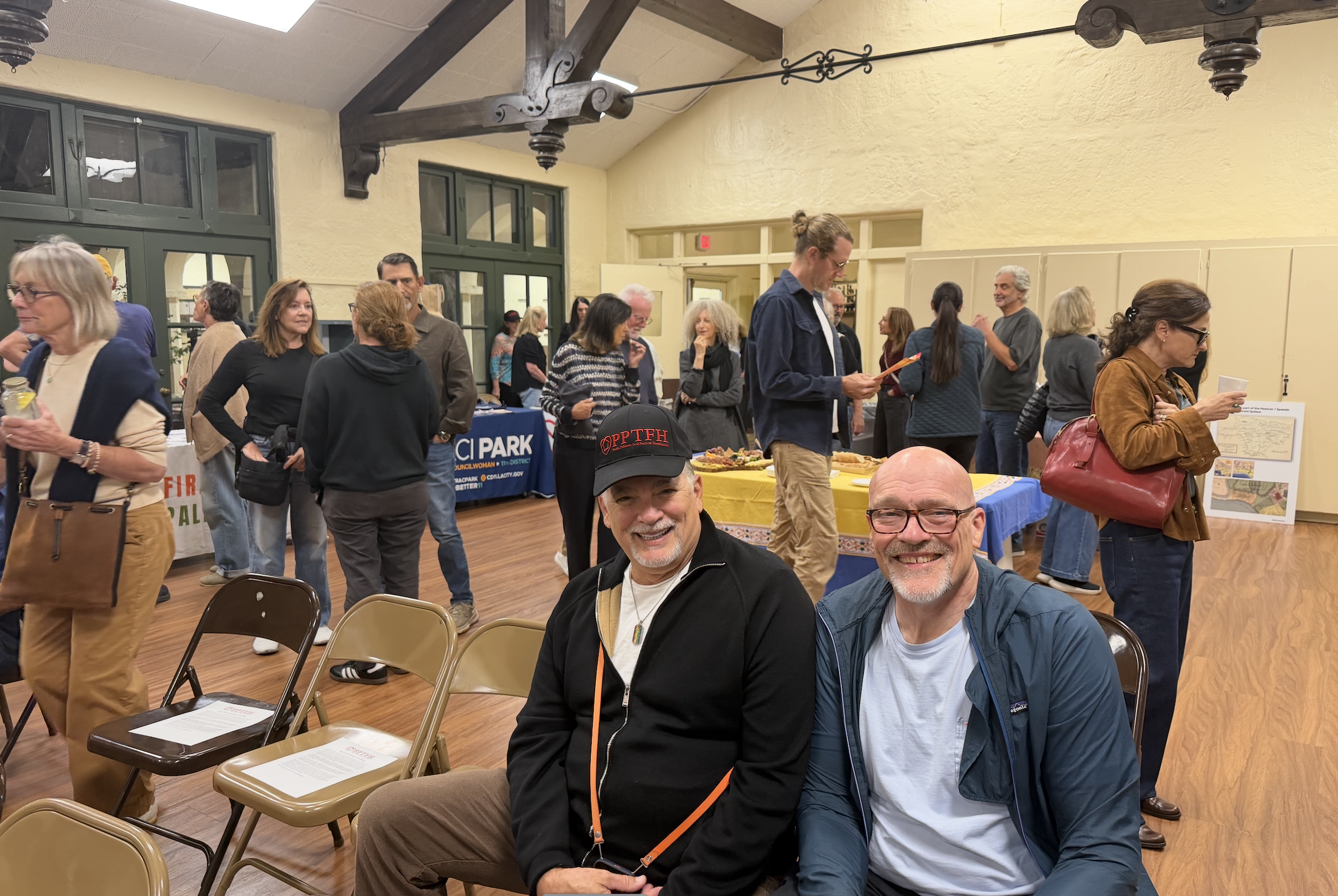
Residents hang out and mill around at The Canyon Alliance annual membership meeting. Photo: Sue Pascoe
